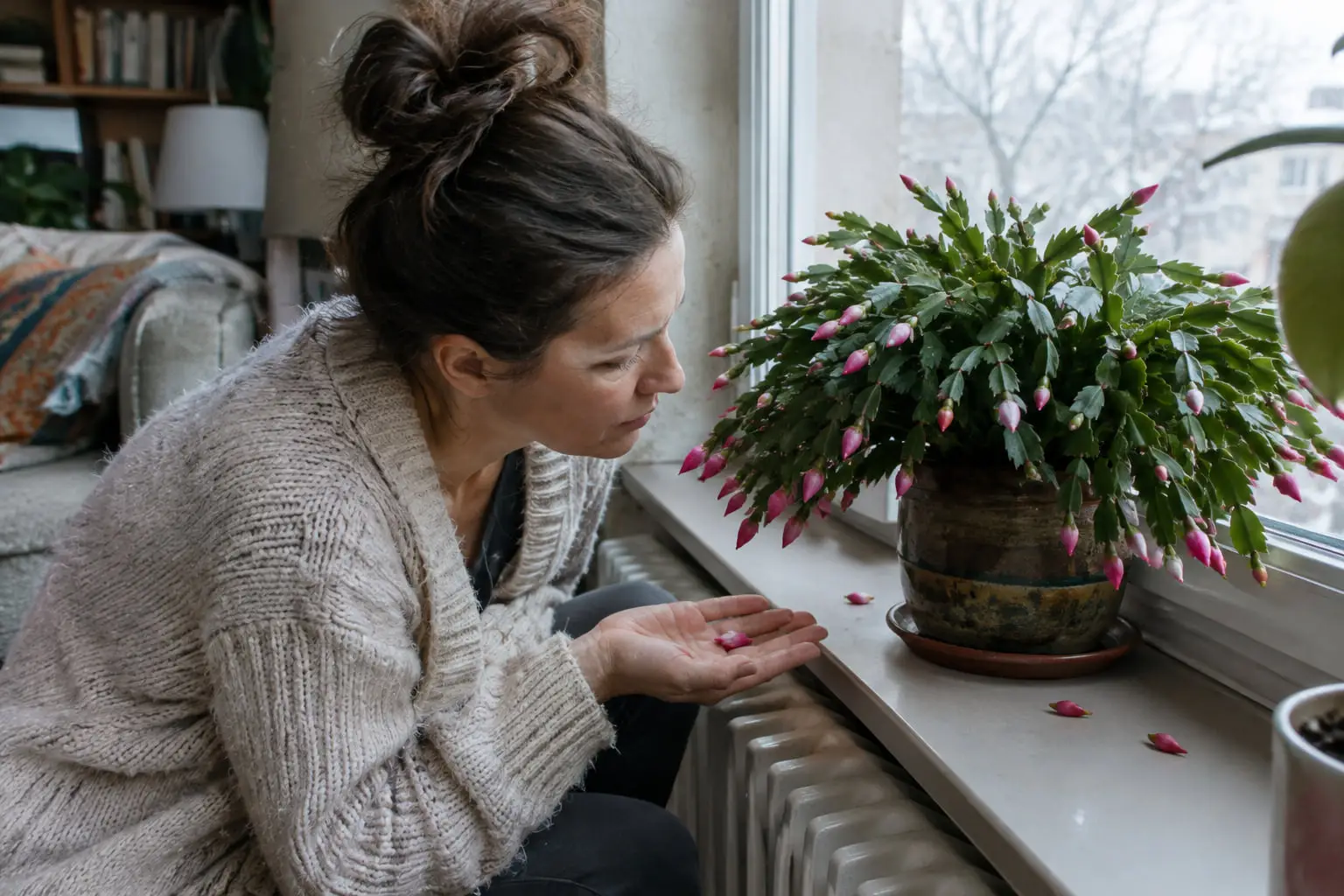
It happens at the worst possible moment. The plant has been covered in fat pink or red buds for a week, you have been waiting for it to flower in time for the holidays, and then one morning there are buds on the windowsill and more come away at a touch. The plant itself looks perfectly healthy. The segments are green and firm. So what went wrong?
Almost always, the answer is change. A Christmas cactus commits a lot of energy to a flush of buds, and when its surroundings shift while those buds are developing, it aborts some or all of them rather than finish flowers it may not be able to support. This guide explains why the plant reacts that way, how to work out which change caused it in your home, what to do with a plant that is shedding right now, and how to set buds next year that actually open.
Why a Christmas cactus is so sensitive in bud
The name misleads people. A Christmas cactus is a cactus botanically, but it is nothing like the desert plants most of us picture. The holiday cacti, the genus Schlumbergera, come from the coastal mountain forests of south-eastern Brazil, where they grow perched on tree branches and mossy rocks rather than in the ground. Their world is shaded, humid, mild and steady. Temperatures change gradually, rain is frequent, and the roots sit in a thin layer of leaf litter that drains instantly but never stays dry for long.
A plant adapted to that kind of stability reads abrupt change as a threat. Shedding buds is a cheap way to cut its losses: flowers are expensive to build and keep open, and a plant that suddenly finds itself in hotter, drier or darker conditions has good reason to abandon them. The mechanism involves the plant hormone ethylene, which rises when a plant is stressed and triggers a weak zone, called an abscission layer, to form at the base of each bud. Once that layer has formed, the bud falls with the slightest nudge. This is why bud drop often looks sudden even though the trigger happened several days earlier.
The common causes, and how to tell which one it is
Several causes often overlap, and a plant that is already under mild stress from one will drop buds at a smaller provocation from another. The table below lists the usual suspects with the clue that points to each, so you can match them to what you see.
| Cause | What usually points to it | What to change |
|---|---|---|
| Moving or rotating the plant | Drop started a few days after you moved it, turned it to face the room or carried it to another window | Choose one spot and leave it there, facing the same way, until the flowers open |
| Recent purchase | Plant was bought in bud within the last three or four weeks | Give it the brightest indirect light you have and keep everything else steady; some loss is normal |
| Heat source | Plant sits near a radiator, heating vent, fireplace, television or on top of an appliance | Move it at least a metre or so away from direct heat, once, and then leave it |
| Cold draught or cold glass | Buds fall after cold nights, the plant touches the window or sits by a door that opens often | Pull it back from the glass and out of the path of doors, especially on frosty nights |
| Soil too wet | Compost stays soggy for days, pot has no drainage or stands in a saucer of water, segments may look limp | Empty the saucer, let the top few centimetres dry, then water again; check the drainage hole |
| Soil too dry | Compost has shrunk from the pot edge, pot feels light, segments look thin or wrinkled | Water thoroughly until it runs out of the base, then keep it evenly moist |
| Very dry air | Central heating is running hard and buds shrivel at the tip before falling | Group plants together or stand the pot on a tray of damp pebbles, clear of the water |
| Too little light | Plant is in a dim room or several metres from a window; buds stall then fall | Move it to a bright spot out of harsh midday sun, then do not move it again |
More than one cause can apply at once. Start with whatever changed most recently.
Moving and turning the plant
This is the cause people least expect, because it seems so harmless. Buds develop facing the light, and when the plant is turned the light arrives from a new angle and the buds have to reorient. A plant that has also been carried to a different room meets a new temperature, a new level of humidity and a different light intensity all at once. Any one of these may be tolerated. Together they are often enough to trigger a drop. Once you see buds, treat the pot as if it were fixed to the windowsill.
The new-plant drop
Most holiday cacti are grown in commercial greenhouses with bright light, cool nights and high humidity, then packed, trucked, displayed under shop lighting and finally carried home through cold air into a warm living room. That is a long sequence of changes in a short time, and losing a portion of the buds in the first few weeks is very common. It is not a sign that you bought a poor plant or did something wrong. Give it the steadiest, brightest conditions you can and resist the urge to keep moving it to find a better spot.
Watering that swings
Because the plant is called a cactus, many owners water it like one, rarely and sparingly. In bud, that is a mistake. A plant carrying buds needs evenly moist compost: not wet, not dry, and not alternating between the two. The opposite error is just as common. A decorative pot without a drainage hole, or a plant left sitting in the water that collects in a foil sleeve, keeps the roots waterlogged, and roots short of oxygen stop working, which the plant registers as drought. The roots of a tree-dwelling plant are built to dry slightly between drinks and never to sit in water.
If you also grow desert species, the contrast is worth knowing: the watering rhythm for small succulents and desert cacti is built around long dry spells, which is close to the opposite of what a Christmas cactus wants in winter.
Christmas, Thanksgiving or Easter cactus: which do you have?
It matters less than people think for bud drop, because all three react to the same stresses, but it explains a lot about timing. Most plants sold as Christmas cactus in shops in November and December are in fact Thanksgiving cactus, Schlumbergera truncata, which naturally flowers earlier. If your plant was in bud in early November, that is probably what you have, and it is behaving normally.
| Plant | Segment shape | Usual flowering time in the northern hemisphere | Flower |
|---|---|---|---|
| Thanksgiving cactus (Schlumbergera truncata) | Two to four sharp, claw-like points along each edge | Late October to December | Held horizontally, slightly lopsided, yellow pollen |
| Christmas cactus (Schlumbergera x buckleyi) | Rounded, scalloped edges with no sharp points | December to January | Hangs down more, symmetrical, pink pollen |
| Easter cactus (Hatiora or Rhipsalidopsis gaertneri) | Rounded segments with small bristles at the tips | March to May | Star-shaped, opening wide, often scarlet or pink |
Look at the edges of the flat stem segments, which most people call leaves.
What to do if your plant is dropping buds right now
You cannot reattach a bud that has already formed its abscission layer, and some buds that are still attached may already be committed to falling. The aim is to stop the cascade so the rest open. Act once, then leave the plant alone.
Rescuing a plant mid-drop
-
Check the soil first
Push a finger 2 to 3 cm into the compost. If it is soggy, empty any saucer or sleeve and tip out standing water. If it is dry, water slowly until it runs from the drainage hole, then let it drain fully.
-
Look for heat and draughts
Feel the air around the plant. If it is near a radiator, vent, stove or the top of a television, or touches cold glass, it needs a better spot.
-
Make one move, if you must
If the current position is the problem, choose the best alternative, a bright room out of direct midday sun and away from heat, and move it there once, keeping the same side facing the window.
-
Raise the humidity gently
Stand the pot on a tray of pebbles with water below the top of the stones, or group it with other plants. Misting has a fleeting effect and wets the buds, so it is not worth much.
-
Stop feeding and repotting
Do not fertilise or repot a plant in bud. Both disturb the roots and add stress at the wrong moment.
-
Wait, without fiddling
Expect a few more buds to fall over the following week as earlier stress plays out. If the remaining ones keep swelling and colouring, the plant has settled.
The right conditions while the buds open
Once the drop has stopped, aim for steady, unremarkable conditions until the last flower fades. The plant does not need anything exotic, it just needs nothing to change.
Conditions for a plant in bud or flower
- Bright, indirect light, such as an east-facing window or a metre back from a sunny one
- Room temperature of about 60 to 70°F (16 to 21°C), with cooler nights welcome as long as they are steady
- Nothing hotter than about 75°F (24°C) for long periods, which encourages buds to fall
- Compost kept evenly moist, watered when the top 2 to 3 cm feels dry
- A pot with a drainage hole and no water left standing in the saucer
- The same position and the same orientation from first bud to last flower
- No fertiliser and no repotting until flowering has finished
Humidity helps but is rarely the whole story on its own. A pebble tray or a group of plants is usually enough. The same principles apply to most humidity-loving houseplants, and if you keep several, the guide to keeping tropical plants healthy indoors through the heating season covers grouping, humidifiers and placement in more detail.
How a Christmas cactus decides to flower
Understanding how buds are set explains both why some plants never flower and how to get a full, stable crop next year. Holiday cacti are short-day plants, though the name is a little misleading. What they actually measure is the length of the uninterrupted night. When nights become long enough in autumn, typically somewhere around 12 to 14 hours of darkness, the plant switches from growing new segments to forming flower buds at the tips.
Temperature can override the night length. In cool conditions, roughly 50 to 55°F (10 to 13°C), most plants set buds regardless of how long the nights are. In a warm room, above roughly 70°F (21°C), many struggle to set buds at all, even with long nights. Between those ranges, darkness is what decides. This is why a plant left on a cool porch or in an unheated spare room in autumn often flowers beautifully, while the same plant in a warm, lamp-lit living room can stay stubbornly green.
Two ways to trigger buds in autumn
Either approach works. Many people use a mix of both, depending on what their home allows.
Long nights
For a plant kept at normal room temperature
- Give the plant around 13 to 14 hours of complete darkness every night for about six weeks
- A spare room nobody uses after dark, or a cupboard each evening with the plant back in the light each morning
- Even brief light from a lamp, a hallway or a street light can reset the clock
- Keep watering a little lighter than usual during this period
Cool nights
For homes with a cool room or sheltered porch
- Keep the plant at roughly 50 to 55°F (10 to 13°C) for about six weeks
- Night length matters much less at these temperatures
- Bring it in before frost; below about 40°F (4 to 5°C) the plant can be damaged
- Once buds are visible, move it to where it will flower and then do not move it again
Year-round care that leads to buds that hold
A plant that has grown well through spring and summer has the reserves to carry a full crop of buds through winter. The cycle is straightforward once you see it as four seasons of different needs.
| Period | What the plant is doing | What to do |
|---|---|---|
| After flowering, roughly January to March | Resting after the effort of flowering | Water less often, let the top of the compost dry a little more, no feeding; repot now if it truly needs it |
| Spring and summer | Growing new segments, which carry next season's buds | Bright indirect light, regular watering, a balanced houseplant feed at half strength every two to four weeks; a shaded spot outdoors is fine once nights stay above about 50°F (10°C) |
| Early autumn, about six weeks before you want buds | Sensing longer nights and cooler air | Stop feeding, water slightly less, give long uninterrupted nights or cool temperatures |
| Bud and flower | Committing energy to flowers | Steady position, evenly moist compost, moderate warmth, no moving, feeding or repotting |
Timings are for a Christmas or Thanksgiving cactus in the northern hemisphere. Shift by six months in the southern hemisphere.
A few extra habits make a difference. Holiday cacti flower best when slightly pot-bound, so move up only one pot size every few years, into a free-draining mix such as two parts houseplant compost to one part orchid bark or perlite. Pinching off the last one or two segments of each stem in early summer makes the plant branch, and every stem tip is a potential bud site. Plants can live for decades, and old, well-branched specimens carry the most flowers.
If the pattern of buds forming and then falling sounds familiar, it is because other flowering houseplants do the same thing. Moth orchids are notorious for it, and the causes are much the same: see the section on bud blast in this practical guide to orchid care at home.
When bud drop points to a bigger problem
Usually, bud drop is the plant reacting to its surroundings and nothing more. Occasionally it is a symptom of a plant that is genuinely unwell. Check for these signs, especially if the plant has also stopped growing or is losing whole segments.
- Soft, translucent or blackened segments at the base, or compost that smells sour: likely root rot from waterlogging. Remove the plant from its pot, cut away mushy brown roots, and repot into fresh, dry, free-draining mix. Healthy cuttings from the top can be rooted as a backup.
- Limp, wrinkled segments even though the soil is wet: also a sign of root damage, since the roots are no longer taking up water.
- Segments turning red or purple: often too much direct sun, cold, or root stress. It is a warning rather than a disease, but worth acting on before next year's buds.
- White cottony tufts in the joints: mealybugs. Dab them with a cotton bud dipped in rubbing alcohol and check every few days until none return.
- Whole segments falling off: stronger stress than simple bud drop, most often overwatering or a sharp cold shock.
Terms worth knowing
- Bud drop
- The shedding of unopened flower buds, usually in response to stress or sudden change.
- Abscission layer
- A band of weak cells that forms at the base of a bud or leaf so that it can detach cleanly from the plant.
- Ethylene
- A gaseous plant hormone that rises under stress and as fruit ripens, and that promotes bud and flower drop.
- Epiphyte
- A plant that grows on another plant, such as a tree branch, for support, taking water and nutrients from rain, air and debris rather than from the ground.
- Short-day plant
- A plant that flowers in response to long nights, which in practice means in autumn or winter.